

The programme is preliminary and may change due to factors beyond our control. We will do our best to keep any changes to a minimum.
ICBSA2026 – Preliminary programme
Secretary of the Congress – James Hargrave
Polish National Organising Committee: M. Matera, R. Karasiewicz-Szczypiorski, P. Dyczek, T. Scholl, A. Deptuła, N. Lockley
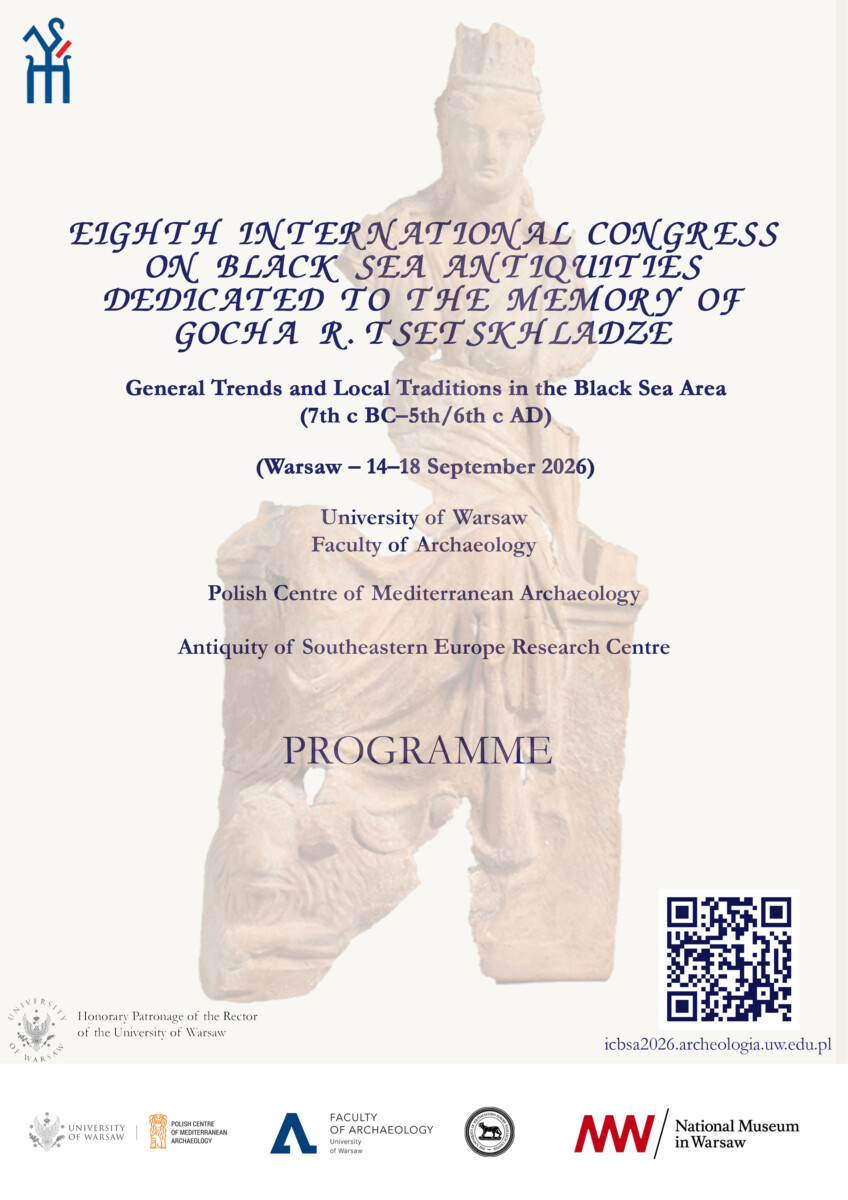
Photography of artefact on the title page:
The National Museum in Warsaw houses a fairly large collection of artefacts from the Black Sea region. The artefact we selected is a terracotta figurine depicting Cybele (inventory no. 225367 MNW) from Polish excavations at Myrmekion. The photography is reproduced from the online collection of the National Museum (https://cyfrowe.mnw.art.pl/en/catalog/490581)
All sessions, as well as coffee and tea breaks from Monday to Thursday, will take place on the Main Campus of the University of Warsaw (26/28 Krakowskie Przedmieście Street), in the Old Library building. Friday sessions will take place at the Tyszkiewicz-Potocki Palace (Museum of the University of Warsaw), 32 Krakowskie Przedmieście Street.
Monday, September 14th
9.00 – Registration of participants
10.00 – Opening Session
10.45 – James Hargrave – Opening Lecture
11.15 – Tea and Coffee break
SESSION 1
The problems of early Greek colonisation on the Black Sea. A Session devoted to Gocha R. Tsetskhladze and his works
11.45
Liviu Mihail Iancu
The Archaic Sanctuary of Istros in the Light of Metal Finds from Recent Archaeological Excavations (1990–2025)
12.00
Alexandre Baralis and Vasilica Lungu
From the Fisherman to the Oikist? Reflections on the Importance of Deltaic Areas at the Very Beginning of the Greek Colonisation
12.15
Nadiya Gavrylyuk and Mykola Tymchenko
Paleoecological-Economic and Climatic Prerequisites of the Colonisation of the Northern Black Sea Area in the Archaic Period
12.30
Emzar Kakhidze
Acculturation of the Coastal Colchian Population in the Classical Period
12.45 – Discussion
13.00-14.30 – Lunch
SESSION 1
Varia
14.30
Hazar Kaba
Of Monsters and Men: On the Iconography of the Classical Pebble Mosaics at Sinope
14.45
Omari Dzadzamia
Sources of Energy in the Diet of Colchians in Classical Antiquity
15.00
Sujatha Chandrasekaran and Fatma Bağdatlı Çam
On the Question of Local Identity and Representation – A Zoomorphic Figure from the Southern Black Sea Littoral
15.15
Stela Tasheva and Sasha Lozanova
The Meander Motif: Forms and Roles in Architectural and Interior Environment
15.30
Tedo Dundua (†) and Natia Phiphia
General Trends and Local Traditions: Georgian Imitations of Alexander- and Lysimachus-type Staters
15.45
Zahra Kouzehgari
From Steppe Traditions to Black Sea Antiquities: Scythians, Cavalry, and Imperial Warfare from the Black Sea to Persia
16.00 – Discussion
16.15-16.45 – Tea and Coffee break
POSTER SESSION
Nicolaie Alexandru, Diana Sonu, Dragoș Hălmagi and Ana Hamat
Archaeological Research in the Hellenistic Necropolis of the Northern Sector of the City of Callatis
Alexandra Bivolaru, Irina Sodoleanu and Nicolae Alexandru
The Environment and the Chora of a Doric colony: Geoarchaeological Insights from Callatis
Livia Buzoianu and Nicolaie Alexandru
Callatis: Ceramic Materials from the 5th–2nd Centuries BC. Recent Discoveries
Mila Chacheva and Daniela Stoyanova
Luxury Furniture from the Hellenistic Necropoleis of Odessos and its Surroundings
Alexandru Codescu
Mapping the Roman Workshops from the North-Western Part of Current Dobruja
Margarit Damyanov
A View of Archaic Sea Trade: Pottery from the Harbour of Apollonia Pontica
Tomasz Dziurdzik
Who, What, Where, When, Why: Challenges of Researching Minor Pre-Second World War Polish Collections of Black Sea Antiquities
Kate Maree Farrow
Inscribed Encounters: Reconstructing Scythian History from Epigraphic Sources in the Pontic Steppe
Lyubava Alexandrova Georgieva
Between the Odrysians and the First Delian League: Apollonia Pontica in the Late 5th–Mid-4th Century BC
Bianca-Elena Grigoraș and Despina Măgureanu
Amphora Imports in the Late Iron Age Settlement from Tinosu, Prahova County, Romania (1st Century BC–1st Century AD)
Mihaela Iacob
The Province of Scythia in the Time of Justinian – Archaeological and Numismatic Sources
Iulia-Alexandra Iliescu and Radu O. Stănescu
Understanding a Journey to the Afterlife – The Ceramic Finds from the Funerary Space of Beidaud, Romania
Kacper Laube
An Egyptologist in Myrmekion
Dragoş Măndescu
Greek Goods in the Ferigile Group. With a Special Focus on the Necropolis at Valea Stânii (Argeș County, Romania)
Elina Mircheva
Lead Mirrors from the Temple of the Pontic Mother of the Gods in Dionysopolis
Alex Radkov
Archaic Cypriot Mortaria from Apollonia Pontica
Constantin Șova and Cristina Talmațchi
Belt Pieces on the Lower Danube in the Late Roman Period
Cristina Talmațchi and Constantin Șova
Some Considerations Regarding Digitated/Bow Fibulae Discovered in Istro-Pontic Territory
Gabriel Mircea Talmațchi and Lucian Munteanu
Aspects of the Practice of Depositing Groups of Coins in Tombs Specific to the Hellenistic Necropolis of Callatis in the Context of Some Unprecedented Discoveries (4th–1st Centuries BC)
Evgenia Velychko
Isis Jewellery from Barbarian Burials of the North Pontic Region
Kalina Yordanova
Ancient Weights of Apollonia Pontica
19.00 – Welcome reception
The welcome reception will take place in the Columned Hall at the Faculty of History, University of Warsaw (26/28 Krakowskie Przedmieście Street).
Tuesday, September 15th
SESSION 2
Greeks and indigenous peoples: mutual relations, cultural interactions, influences on material culture.
9.00
Marcin Matera
Περὶ τοῦ πῶς χρὴ πολιορκουμένους ἀντέχειν. Once Again About the Hellenistic Fortifications of Tanais
9.15
Aleksandra Deptuła
Maeotian, Sarmatian or Local? About Technological and Stylistic Features as an Ethno-cultural Indicator of Gray Ware from the Lower Don Region.
9.30
Maya Vassileva
Greeks, Lydians and Persians in Gordion
09.45
Tsvete Lazova
The Making of the Megalithic Culture in Bulgaria: Social Construction of Religious Landscape and its ‘Authorised Heritage Discourse’
10.00 – Discussion
10.15-10.45 – Tea and Coffee break
10.45
Valeriu Sîrbu and Sebastian Matei
Ceremonies Dedicated to Dionysos Among the Dacians? A Modiolus with Figurative Representations from the Fortress of Pietroasa Mică (Romania)
11.00
Gabriel Mircea Talmațchi and Sebastian Matei
On the Pre-Roman Habitation Before the municipium Tropaeum Traiani. Archaeological Discoveries Specific to the 4th Century BC–1st Century
11.15
Francesca Fariello
Eurasian Connections. Greeks and Scythians: Cultural Influences from the Black Sea Area to the Nomadic Routes of China (Second Half of the 1st Millennium BC–Beginning of Our Era)
11.30
Luigi Gallo
Crimea, between the Persian Empire and the Athenian Empire
11.45 – Discussion
12.00-13.30 – Lunch
13.30
Oskar Kubrak
Surprises and Unexpected Developments at Roman Military Outposts Beyond the Empire’s Borders on the North-Western Coast of the Black Sea.
13.45
Eugenia Michailidou
Monumental Tombs in Thrace: A Tale of Intercultural Influences and Emulations
14.00
Lynn E. Roller
The Mother Goddess in the Black Sea Region: Encounters between Phrygian and Greek Cult
14.15
Viktorya Vasilyan
Graeco-Roman Culture and Hellenistic Armenian/Pontic Iconography
14.30
Alexandar Portalsky
Ethnos and Polis circa Pontus Euxeinos and Beyond
14.45 – Discussion
15.00-15.30 – Tea and Coffee break
15.30
Jan G. de Boer
Highway to the Hinterland
15.45
Liu Shumeng
Regional Governance and Diplomatic Strategies of the Bosporan Kingdom Driven by Grain Resources
16.00
Andrei Corobcean
The Fortified Site at Stolniceni (Hâncești district, Republic of Moldova) in the Context of the Getic Culture of the Pruth-Dniester Region
16.15 – Discussion
Wednesday, September 16th
Mid-Congress excursion
Thursday, September 17th
SESSION 3
New powers in the Black Sea region: Romans, Byzantines, Goths and Huns.
9.00
Natalia Lockley and Bogusław Franczyk
Common Ware from Apsaros: Insights into the Provenance and Supply Systems of the Roman Garrison
9.15
Irina Demetradze-Renz and Eka Avaliani
Roman Imperial Silverware: Diplomatic Gifts or Spoils of War?
9.30
Radosław Karasiewicz-Szczypiorski and Leszek Łęczyński
The Roman Fort of Apsaros (Gonio, Georgia) and Its Surroundings. Attempt at Reconstruction (Architecture and Environment)
9.45
Piotr Dyczek
Pontic Novae
10.00
Zdravko Dimitrov
Development of the Corinthian Order along the Western Pontic Coast During the Roman and Late Antique Eras
10.15 – Discussion
10.30-11.00 – Tea and Coffee break
11.00
Davit Lomitashvili, Besik Lortkipanidze and Nikoloz Murgulia
An Ostrogothic-Type Buckle from Nokalakevi-Archaeopolis (West Georgia) as Evidence for Ethnic Diversity in the Byzantine Army of Lazica
11.15
Adela Bâltâc, Eugen Paraschiv-Grigore and Virgil Apostol
New Style in an Old City. A Roman Insula at Histria (Constanta County, Romania)
11.30
Karl Strobel
Names versus Ethnicity: New Approaches to the Ethnic and Socio-political History of the Northern and Western Black Sea-Region in Roman Times
11.45
Piotr Jaworski
An Unknown Type of Countermark on Coins Discovered at Apsaros: Analysis and Interpretation
12.00
Dan Ruscu
A Late Antique Elite Residence at Istros
12.15 – Discussion
12.30 – 14.00 – Lunch
14.00
Valentin-Victor Bottez, Iulia Iliescu, Alexandra Țârlea, Alexandra Lițu, Mihai Mănescu, Virgil Apostol, Mihaela Golea and Horia Dinu
Functioning Spaces and Function of Spaces. Recent Research in a Late Antique insula on the Acropolis of Istros/Histria (Romania)
14.15
Maciej Marciniak
Across the Black Sea with Jupiter Dolichenus
14.30
Oksana Ruchynska
Game Boards and the Cultural Context of Play in Chersonesos Taurica
14.45
Vlad Vornic and Sergiu Matveev
Contributions to the research of the Hun-Period in the Prut-Dniester area: The tomb with polychrome pieces from Costești
15.00 – Discussion
15.15-15.45 – Tea and Coffee break
15.45
Renata Ciołek
Coinage of the Western Black Sea Cities in the Roman Period: Between Hellenistic Tradition and Provincial Realities
16.00
Ligia Ruscu and Teodora-Ioana Bulai
Hymnodoi. Associations of Hymn Singers in Cities Around the Black Sea
16.15
Füsun Tülek and Kaan Oytun Arabacı
A Group of Amphorae from the Southern Black Sea Shore
16.30
Adriana Panaite and Constantin Bajenaru
Aspects of the Organisation of the Rural Territory of the City of Tomis in the Roman Period
16.45
Eleni Mentesidou
From the Capital of the Hellenistic Kingdom of Pontus to a Roman Colony: Religious Transformation in Sinope
17.00
Gaëlle Granier, Elodie Caserta, Valentin-Victor Bottez and Iulia Iliescu
Land Occupation and Funerary Practices in the Roman Period: An Interdisciplinary and Archaeothanatological Approach to the Settlement and Funerary Area of Beidaud in the Landscape of Moesia Inferior
17.15 – Discussion
Friday, September 18th
SESSION 4
New Excavations and Projects
All sessions on this day will take place at the Tyszkiewicz-Potocki Palace (Museum of the University of Warsaw), 32 Krakowskie Przedmieście Street
9.00
Oksana Lifantii
From ‘Golden Island in the Black Sea’ to the ‘Treasures of Crimea. Return’: The Story of Disputed Collections from Four Crimean Museums
9.15
Hristo Preshlenov
House-Building in Deultum-Develtos-Debelt (Bulgaria)
9.30
Paulina Komar
Tracing Origins: Archaeometric Analyses of Amphorae from Ancient Apsaros (Today’s Gonio, Georgia)
9.45
Lucrețiu Bîrliba
Roads-Customs-Army. About a New Project on Beneficiarii in Moesia Inferior and Dacia
10.00 – Discussion
10.15-10.45 – Tea and Coffee break
10.45
Mariana-Cristina Popescu, Dragoș Măndescu, Gabriela Gheorghiu and Beatrice Mag
1001_Shards. Micro-regional Ceramic Centers in Pre-Roman Dacia (2nd Century BC–1st Century AD)
11.00
Fatma Bağdatlı Çam, Handan Bilici and Umut Bostancı
The New Excavations of a Paphlagonian Roman City: Amastris
11.15
Petre Colțeanu, Natalia Mateevici, Laura Gheorghiu, Irina Sodoleanu and Ioana Dorcu
Medgidia Hellenistic Project, an Emporion between Worlds?
11.30
Mariya Avramova
Continuity of Worship: The Sacred Spring of Aquae Calidae in Antiquity
11.45
Thibaut Castelli
Timbrer autour de la mer Noire: une pratique polysémique
12.00 – Discussion
12.15-13.45 – Lunch
13.45
Ayşe Fatma Erol and Ertaç Yıldırım
Evaluations of Iron Finds from the Fatsa Cıngırt Kayası 2024–25 Excavation Seasons
14.00
Adrianna Gizińska
Argamum: Investigating the Storage Quarter of the Northern Sector intra muros – Results from Recent Fieldwork
14.15
Martin Lemke, George Nuţu and Michal Pisz
A New Late Roman Fortified Settlement in the Northern Dobruja
14.30
Dragoș Hălmagi and Adela Bâltâc
New Greek Inscriptions from Histria
14.45 – Discussion
15.00-15.30 – Tea and Coffee break
15.30
Valentin-Victor Bottez, Iulia Iliescu, Alexandra Țârlea, Radu Stănescu and Adrian Șerbănescu
Uncovering the Rural Landscapes of Istros/Histria during the Roman Period. New Research in the Beidaud Archaeological Microzone (Romania)
15.45
Alexandra Bivolaru and Tatiana Theodoropolou
Changing Environments, Changing Practices? A Geoarchaeological and Archaeo-ichthyological Perspective from the Southern Danube Delta in Graeco-Roman Times
16.00
Nicolas Garnier, Alexandre Baralis and Teodora Bogdanova
About the Actual Contents of Vases in Funerary Contexts. The Case of the Necropolis of Apollonia Pontica
16.15
Aikaterini Gounari and Manolis Manoledakis
Detecting and Predicting Archaeological Sites in the Southern Black Sea Littoral using Satellite Remote Sensing and Machine Learning
16.30
Paolo Maranzana and Adem Yurtsever
Recent Archaeological Investigations at Pessinus: From Landscape Survey to New Excavations.
16.45 – Discussion
17.00 – Closing Session
19.00 – Farewell reception
The farewell reception will take place at the Tyszkiewicz-Potocki Palace (Museum of the University of Warsaw), 32 Krakowskie Przedmieście Street.